

Until I turned 12, I was educated in the French educational framework, where drama meant classical French playwrights. Going to the theatre typically involved productions like The Sound of Music or My Fair Lady. Then, a decision was made that I would switch to an English school. So, at thirteen, I started at Westminster School. It was the late sixties, and the world opened up.
I attended a school production of Waiting for Godot performed in French in a small room with a modest platform, and I was sitting at the rear. Musically, I was pretty sophisticated – I was familiar with all the psychedelic music that had been emerging. I’d seen the Mothers of Invention. I’d seen lots and lots. But I didn’t know there was material of this kind. I suddenly became aware that, similar to music, there was a completely different realm out there.
I am unsure how good the French was, but it wasn’t important what they were expressing. It was just so abstract and vibrant, with a sort of pent-up tension. And then, naturally, it erupts with Pozzo and Lucky’s arrival. The show was put on by older boys, including Nigel Planer as Lucky. He was such a presence on stage. And he must perform that highly elaborate speech. In French. It was astonishing.
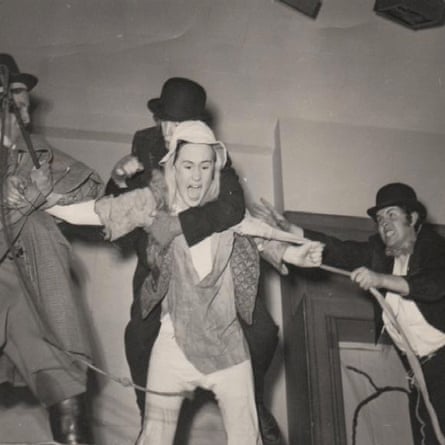
I was captivated by the notion that very little needed to occur, you know? That an event took place and then it continues endlessly and then you have the young messenger at the end stating that Godot is not arriving today. It spoke about temporality and activity and plot. Or the lack thereof.
We had been taught all these rules about what drama was, but they were irrelevant here. I was absolutely fascinated by the minimal action. Years afterward when I was mixing records, I would try to turn them into something similar. When a new instrument came in, I’d pull out other instruments and intentionally highlight them. So you really heard that keyboard or that guitar or whichever element. That idea of less is more … I learned that with Godot.
And yet it has a story. It truly does. I mean, they are well-developed personas. They are so alive, Vladimir and Estragon, in their mutual affection, like an old married couple. I don’t know how my life would have evolved if I hadn’t gone that show. To that school and that play then. It just awakened something in me.
We were released on weekend days, and I started going afternoon shows at the Royal Court every time there was a new production. So you would experience works by modern playwrights. But the gateway to all of this was Godot.
I have so little recollection of the actual show, except I know that it was never boring – it had me at the height of anticipation. What I learned is that there need not be any rules. It certainly shaped how I worked with the bands that I signed to my label. I even had the Waitresses compose a track around “I Can’t Go On, I’ll Go On”. I just told them: “I want a song with this title.”
I think it made me more fearless, too, because you don’t need to worry about setbacks if you subscribe to the playwright’s philosophy.


